

 Home
Home(function(){var bar=document.getElementById(‘gilblog-read-progress’);if(!bar)return;function ao(){var ab=document.getElementById(‘wpadminbar’);return ab?ab.offsetHeight:0;}function upd(){bar.style.top=ao()+’px’;var d=document.documentElement;var t=window.scrollY||window.pageYOffset||(d.scrollTop||document.body.scrollTop)||0;var h=(d.scrollHeight||document.body.scrollHeight)-window.innerHeight;bar.style.width=(h>0?Math.min(100,Math.round(t/h*100)):0)+’%’;}window.addEventListener(‘scroll’,upd,{passive:true});window.addEventListener(‘resize’,upd,{passive:true});upd();})();
In this article
- The quick verdict
- Steel garage doors: the practical standard
- Wood garage doors: premium aesthetics, real upkeep
- Aluminum garage doors: modern and rust-proof
- Side-by-side material comparison
- What Ontario’s climate does to each material
- How to decide which material is right for you
- Frequently asked questions
The best garage door material is the one that matches your budget, your aesthetic, and how much maintenance you are willing to do. Steel, wood, and aluminum each have distinct strengths, and each has a failure mode that surprises homeowners who did not research before buying. Choosing the best garage door material for your specific situation means understanding those trade-offs up front.
This guide breaks down all three materials on the factors that matter for Ottawa homeowners, cost, durability, insulation, maintenance, and suitability for Ontario’s climate. The comparison table in the middle gives you everything at a glance. The decision framework at the end walks you through choosing based on your own situation.
The Quick Verdict
People often ask: which garage door material is best?
For most homeowners, steel. It handles Ontario freeze-thaw cycles without warping, delivers the best insulation value per dollar, and requires minimal maintenance. Wood is the right answer if you want the finest material and will actually maintain it. Aluminum is the right answer if you want a contemporary full-view glass door or need rust immunity near water.
That said, the right answer depends on four variables specific to your situation, your budget, your home’s architectural style, whether the garage is attached, and how much time you will put into maintenance. The sections below give you everything you need to make that call confidently. If you’re still unsure, our professionals can help you decide which garage door to get installed.
Steel Garage Doors: the Practical Standard
Steel is the dominant material in Canadian residential garage doors for straightforward reasons: it handles the freeze-thaw cycle well, it can be insulated to high R-values, it takes paint and texture well enough to mimic wood convincingly, and it costs less than its alternatives.
What makes steel the go-to choice
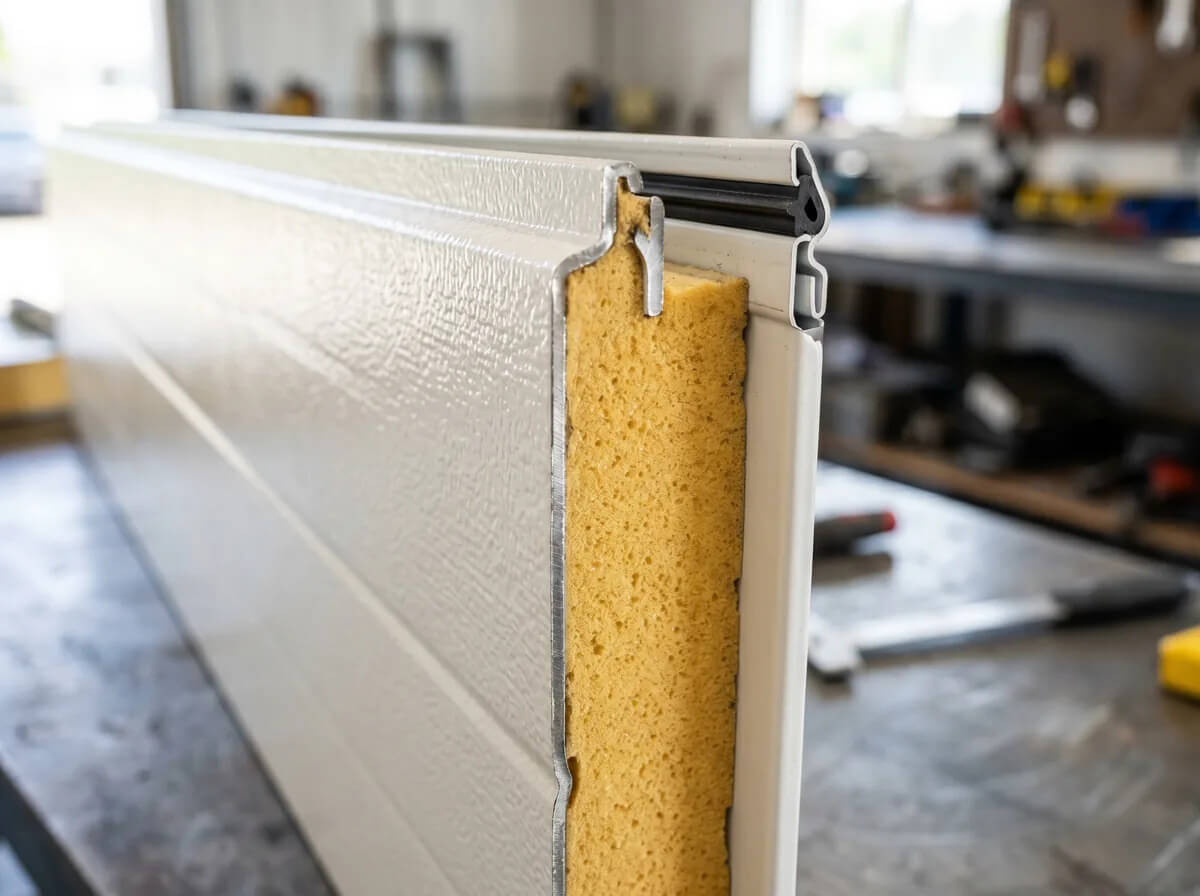
- Insulation options: Triple-layer steel doors with polyurethane foam cores reach R-16 to R-17 – the highest insulation available in a residential garage door. Polyurethane bonds to both steel face sheets, adding structural rigidity along with thermal performance.
- Style flexibility: Steel is available in raised-panel, flush, carriage-style, and full-view configurations. You can get a steel door that mimics wood grain convincingly at a fraction of the cost.
- Low maintenance: A quality factory finish on steel requires almost no maintenance. Touch up any chips or scratches with matching paint to prevent rust propagation, and clean the surface annually.
- Lifespan: 20 to 30 years with normal care. Springs and hardware typically need service before the door itself does.
Where steel falls short
Steel dents. A hockey puck, a shopping cart, or a hailstorm can leave permanent dents in standard 24-gauge doors. Thicker 22-gauge steel doors resist denting significantly better, and some manufacturers offer dent-resistant designs. Steel can also rust along the bottom panel if the coating is compromised and water sits in contact with bare metal – the bottom section is the most common failure point on older steel doors in Ottawa’s salt-spray winters.
Wood Garage Doors,Premium Aesthetics, Real Upkeep
No manufactured alternative fully replicates real wood. The grain, the depth, the natural variation in tone – a real wood carriage-house door on the right home is visually striking in a way that steel and aluminum simply are not. That aesthetic premium is real. So is the maintenance burden.
What makes wood worth it
- Visual quality: Cedar, redwood, and mahogany offer warmth and grain variation that no embossed steel door can fully match at close range.
- Customization: Real wood can be custom-sized, custom-profiled, and custom-finished in any colour or stain. Heritage properties with non-standard opening sizes are candidates for wood for this reason.
- Repairability: A dented steel panel typically needs replacement. A damaged wood section can often be repaired, patched, or replaced plank-by-plank.
The maintenance reality in Ontario
This is where most wood door owners are caught off guard. Wood absorbs moisture. Ottawa has a lot of moisture with spring rains, summer humidity, winter ice and snow. A real wood door that is not sanded, primed, and re-stained or repainted every two to three years will begin showing cracking, paint peeling, and swelling at the bottom panels within five to seven years.
Red flag
If you are considering a real wood door primarily for the look, check the bottom section condition on any wood door you see in your neighbourhood. Bottom section rot and paint failure are the most common failure modes. If you see them on neighbour’s doors, the maintenance standard in your area may not support a wood door long-term.
A faux-wood steel door with an embossed finish solves this problem cleanly. At the distance from which most people view a home facade, the visual difference is minimal. The maintenance difference is enormous.
Aluminum Garage Doors, Modern and Rust-Proof
Aluminum has been gaining market share steadily, driven by the demand for full-view glass doors on contemporary homes. It has three genuine advantages over steel: it does not rust, it is lighter (easier on opener mechanisms and springs), and it forms into large glass panel frames more elegantly than steel can.
Where aluminum excels
- Contemporary and full-view designs: The best-looking full-view aluminum doors with clear, frosted, or tinted glass are an architectural feature, not just a functional garage door.
- Coastal and lakefront properties: Near Lake Ontario, the salty moisture-laden air accelerates steel corrosion. Aluminum’s inherent rust resistance is a real practical advantage.
- Lightweight for wide openings: Very wide openings (18 feet or more) benefit from aluminum’s lower weight, which reduces stress on the opener motor and torsion spring system.
Where aluminum falls short
Aluminum dents more easily than steel. It also has lower standard insulation values – though thermally broken aluminum frames with argon-filled glass can achieve reasonable thermal performance. For an attached garage in Ottawa that experiences -25C winters, a standard aluminum door may not provide adequate insulation without a significant upgrade in glazing specification.
Did you know?
Thermally broken aluminum frames – where the interior and exterior aluminum sections are separated by a thermal barrier material – can dramatically improve the insulation performance of an aluminum door. Ask specifically for thermally broken construction if insulation matters for your application.
Side-by-Side Material Comparison
| Factor | Steel | Wood | Aluminum |
|---|---|---|---|
| Durability (dent resistance) | Good (heavier gauge = better) | Moderate (can repair) | Fair (dents easily) |
| Insulation (R-value) | Excellent – up to R-17 | Poor – minimal unless added | Fair – up to ~R-10 insulated |
| Maintenance requirement | Low | High | Very low |
| Rust/corrosion resistance | Good if coating intact | N/A – rots instead | Excellent – never rusts |
| Style range | Very wide | Custom only | Contemporary/modern |
| Typical lifespan | 20 to 30 years | 15 to 30 years (maintained) | 20 to 30 years |
| Best suited for | Most homes and climates | Heritage/luxury properties | Contemporary builds, coastal |
What Ontario’s Climate Does to Each Material
This is the question most buyers don’t ask until they are looking at a failed door. Ontario’s climate is genuinely hard on building materials. Ottawa in particular delivers the full range: summer heat above 35C, winter lows below -25C, and dozens of freeze-thaw cycles between October and April. Here is how each material handles it.
| Climate factor | Steel response | Wood response | Aluminum response |
|---|---|---|---|
| Freeze-thaw cycles | Stable – no dimensional change | Expands/contracts – cracks paint, can jam | Stable – no dimensional change |
| Winter salt exposure | Bottom rust risk if coating damaged | Accelerates rot at base | No effect – rust-proof |
| UV exposure | Fade over 10-15 years without quality coating | Requires re-staining or repainting | Anodized finish resists UV well |
| Hail | Can dent (heavier gauge resists better) | Can crack or splinter | Dents easily |
| Spring moisture | Minimal risk if drained properly | High risk – swelling, rot | No risk |
The practical takeaway for Ottawa: steel with a quality coating is the low-risk choice. Wood is manageable but requires vigilance. Aluminum has no moisture vulnerability but needs thoughtful insulation specification for an attached garage.
How to Decide Which Material is Right for you
Choose steel if
- You want the best insulation value per dollar for an attached garage
- Low maintenance is important to you
- You want flexibility in styles (carriage, raised-panel, flush, contemporary)
- You are working with a standard budget
- You live in Ottawa and want reliable performance through severe winters
Choose wood if
- The visual quality of real wood is non-negotiable for your home
- You have a heritage or custom home that warrants the craftsmanship
- You will commit to re-staining or repainting every 2 to 3 years
- Budget is not the primary constraint
Choose aluminum if
- You want a contemporary full-view glass door for a modern home
- The property is near Lake Ontario or another moisture-heavy environment
- You have a very wide opening where weight is a factor
- Rust resistance is a priority
Save your money
If you love the look of wood but don’t want the maintenance, a faux-wood steel door saves you money and requires no staining. The embossed grain pattern on modern steel doors looks genuine at any viewing distance you would actually see the door from.
Wrapping it up
There’s no one-size-fits-all answer, only the right fit for your home. Steel offers the best balance for most Ottawa homeowners, wood delivers unmatched character with added upkeep, and aluminum suits modern designs and moisture-prone areas. Focus on how your garage is used, your maintenance tolerance, and your budget. When those factors align with the right material, you end up with a door that performs well, lasts longer, and actually complements your home.
Download the free quick guide
Save this reference guide with the full material comparison and decision checklist for your next door shopping session.
Download the material selection guideReady to upgrade your garage door?
Berintek supplies and installs steel, wood, and aluminum garage doors across Ottawa, Kanata, Nepean, Barrhaven, Orleans and beyond. We can walk through the right material choice for your specific home and opening during a free estimate visit.
Get a free estimate