

 Home
HomeThe honest answer to chain drive vs belt drive garage door opener comes down to two questions: how loud is too loud for your house, and how long do you want the unit to last. Chain drives are louder, cheaper, and run a few years longer. Belt drives are quieter, cost more upfront, and demand almost no maintenance. If a bedroom sits over the garage in your Ottawa home, the choice is essentially made for you. For an attached garage door installation in Ottawa where someone sleeps above, belt drive wins. For a detached garage or a basement-bedroom layout, chain drive is the smarter spend.
Both technologies move the door using the same trolley and rail concept. The difference is the drive medium. A chain drive pulls the trolley along the rail using a steel chain that wraps around a sprocket on the motor head. A belt drive uses a steel-reinforced rubber belt instead. The belt is the same idea as a serpentine belt in a car: quieter, smoother, and lower maintenance, with shorter overall lifespan compared to the equivalent chain assembly.
In this article
How chain and belt drives actually work
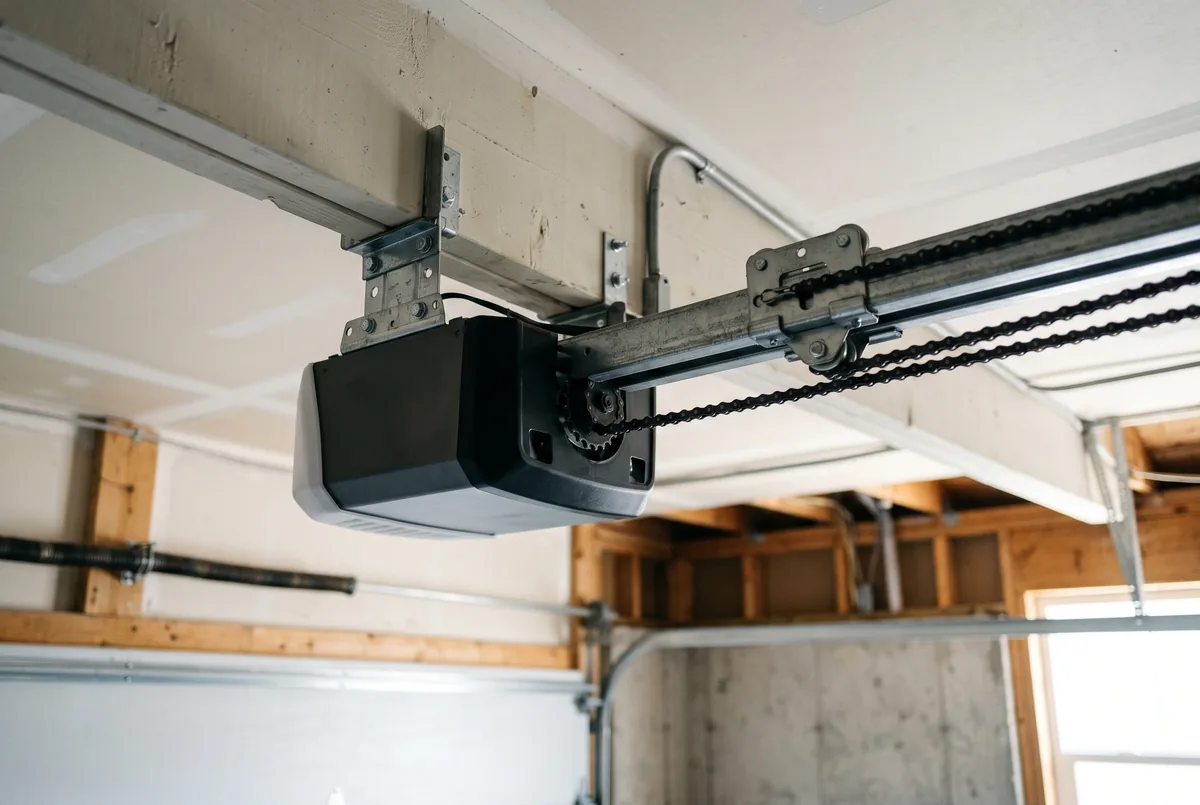
Picture the rail running from the motor unit (mounted near the back wall of the garage ceiling) out toward the door. Inside that rail sits a small carriage called a trolley. The trolley is connected to the top of the door by an arm. When the motor turns, it pulls the trolley along the rail, which lifts or lowers the door.
The chain or belt is what physically moves the trolley. A chain drive uses a steel roller chain wrapped between a sprocket on the motor head and an idler at the far end of the rail. A belt drive uses a rubber belt with embedded steel cords, looped around a pulley wheel instead of a sprocket. Both deliver the same lifting force. They feel and sound completely different.
Noise: the practical difference
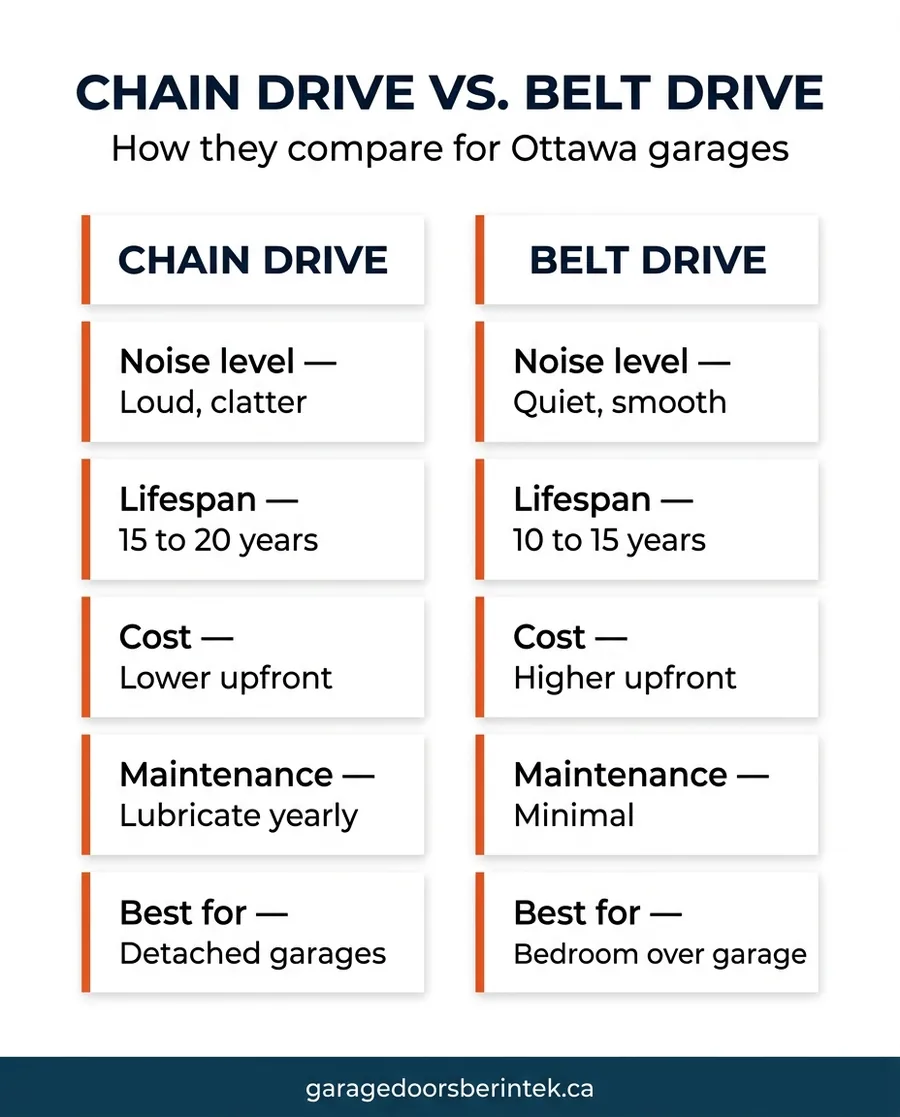
This is where the real-world choice gets made. A chain drive opener produces between 60 and 75 decibels at the motor head while running. That’s roughly the same as a vacuum cleaner. The metallic clatter is structure-borne too, meaning the noise travels up through the ceiling joists into the room above more easily than airborne sound.
A belt drive runs at 50 to 60 decibels. That’s quiet conversation territory. More importantly, the rubber belt does not transmit metallic vibration the way a steel chain does. A belt drive opener running at 6:30am with a child sleeping in the bedroom directly above the garage is the difference between a noticeable rumble and barely registering at all.
People often ask: does a belt drive make my whole house quieter?
Only the part of the house adjacent to the garage. If the noise complaint is “I can hear the garage door open from the kitchen,” a belt drive solves it. If the complaint is “I can hear the door from the second-floor bedroom on the opposite end of the house,” the issue is more likely the door itself (worn rollers, unbalanced spring) than the opener type.
Lifespan and maintenance
A chain drive opener has more service life on paper. Expect 15 to 20 years from a quality unit (LiftMaster, Chamberlain, Genie professional series), provided the chain is lubricated annually and the door itself is properly balanced. The chain stretches over time, so a tension adjustment every 2 to 3 years keeps the system running quietly and smoothly.
A belt drive runs 10 to 15 years before the belt or trolley shows enough wear to justify replacement. The belt itself almost never breaks suddenly. What you’ll notice first is a slight vibration at low speeds, then occasional slipping under load. The motor head and logic board often outlast the belt. Maintenance is essentially zero: no lubrication, no tension adjustment, no annual servicing on the drive itself. Just an opener safety check.
Pro tip
If you have a chain drive that has lasted 17 years and is starting to sound rougher, the answer is rarely “replace the opener.” More often it’s “replace the chain and re-tension.” A new chain kit runs $80 to $140 in parts. Replacing the entire opener for a chain that’s stretched is overkill on a unit with a working motor and modern logic board.
Ottawa cold and what it does to each type
Ottawa winters routinely drop to minus 25 degrees Celsius and below. Both opener types handle the cold, but they handle it differently.
A steel chain contracts in deep cold, which tightens the chain and adds stress to the motor and sprocket. After a long cold snap, you may notice a stiffer, slower lift on the first run of the morning. The fix is usually a tension adjustment in spring once temperatures normalize. A reinforced rubber belt also contracts slightly but holds its tension far more consistently across the temperature range, which is why most installers in Ottawa garage door repair recommend belt for any house where the garage is unheated.
One important note: the motor itself is not the bottleneck in cold weather. The springs, rollers, and door balance matter far more. If the door feels heavy or the opener is straining at minus 20, the springs are usually the issue, not the drive type. Per the Ontario Building Code, residential garage doors must include compliant safety reversal sensors, and an opener that struggles with weight on a cold morning will often trip the auto-reverse, which masks the underlying spring issue.
Which one to pick for your house
Five quick scenarios to settle the decision:
- Bedroom directly above the garage: belt drive. Not negotiable. Save the noise complaint.
- Detached garage, anywhere on the property: chain drive. The house never hears it. Save the money.
- Attached garage with main floor adjacent (kitchen, mudroom): belt drive. The hum is barely audible inside the house, and morning departures will not wake anyone.
- Heavy double-car wood door, 16 feet wide: chain drive (3/4 HP minimum). Belts can lift this weight, but a chain handles it with more headroom over the long term.
Save your money
Whatever drive type you choose, pick a unit with a DC motor instead of AC. DC motors run quieter, use less power, support battery backup, and ramp up and slow down at the ends of door travel (called “soft start, soft stop”). The price premium over an AC motor is worth every dollar. ENERGY STAR certified models are clearly labelled. Reference the ENERGY STAR Canada residential program for current efficient model listings.
Download the free quick decision guide
Save the chain vs belt comparison as a PDF and keep it handy when you start shopping for an opener.
Berintek installs and replaces both chain drive and belt drive openers across Ottawa, Kanata, Orleans, Nepean, and Gatineau. If your existing opener is past 12 years and acting up, we can usually diagnose the issue same-day and quote replacement on the spot. Get a free estimate at our quote request page.
Frequently asked questions
.gilblog-faq details[open] .faq-icon{transform:rotate(45deg)}
Get a free written estimate for a new opener or talk to a Berintek technician about whether your current unit is worth fixing or replacing.